
Published July 27, 2026
How Much Have Las Vegas Home Prices Increased Since 2016?

If you bought a home in Las Vegas ten years ago, you've likely done better than you think -- and if you're shopping today, you're buying into a market that's already worked through most of that run-up. A new ranking puts numbers on both halves of that story.
What did the new report find about Las Vegas home prices?
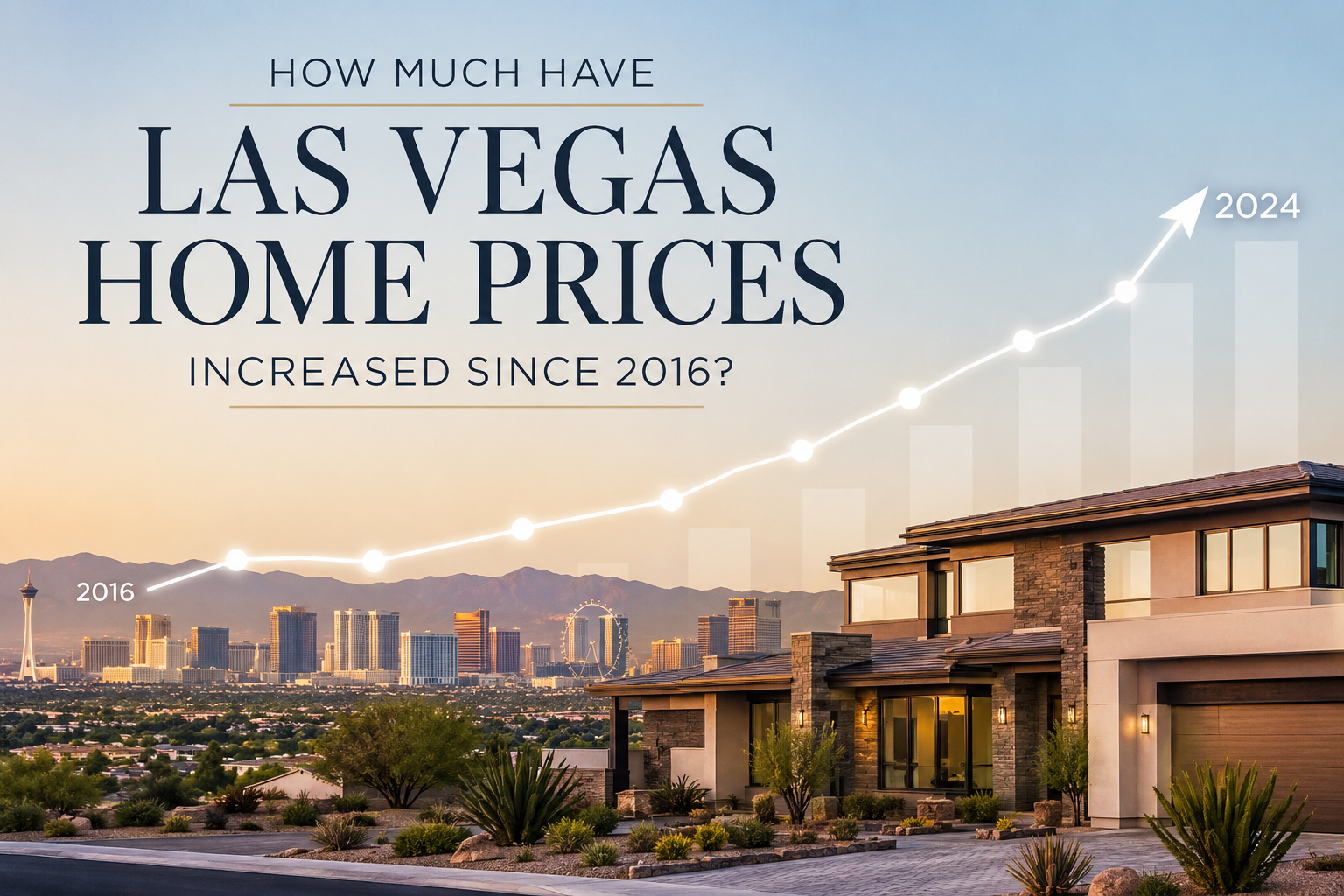
Construction Coverage, a research firm, analyzed Zillow Home Value Index data for nearly 700 U.S. cities, comparing median home values from March 2016 to March 2026 and ranking the results within population-size cohorts. Among "large cities" (populations above 350,000), Las Vegas placed 9th nationally with a 104.2% increase over the decade -- climbing from approximately $208,000 in 2016 to $425,535 today. For context, the report found the typical U.S. home gained about 81% nationally over the same stretch, while average hourly wages rose only 47%, so Las Vegas outpaced both the national home-price trend and, by a wide margin, local wage growth.
Detroit topped the large-city list at 138.7%, followed by Milwaukee, Tampa, Indianapolis, Columbus, Charlotte, and Cleveland, with Kansas City just ahead of Las Vegas in 8th at 107.2%. Jacksonville rounded out the top 10 at 99.6%. Notably, every city on the list is a Sun Belt or Rust Belt metro -- traditionally pricier coastal markets like San Francisco and Oakland posted some of the slowest 10-year appreciation in the country, each gaining barely more than 14%, according to the same analysis.
How does $425,535 compare to what homes are actually selling for here?
It's worth being precise about what's being measured. The Zillow Home Value Index is an estimated value across the entire housing stock, not a median of actual closed sales. Las Vegas REALTORS' own MLS statistics -- the trade association's most recently published market report -- put the median single-family home sale price at $538,000, with condos and townhomes at $279,900. Those figures measure something different: real closed transactions in a given month, which naturally skew toward larger, detached single-family homes rather than the full mix of property types Zillow's index tracks. Both data sets point the same direction -- Las Vegas prices are well above where they sat a decade ago -- but they're not directly interchangeable, and it's a distinction worth understanding before you compare any single number you see quoted online to what a specific home might actually sell for.
Why did Las Vegas prices rise so sharply from such a low starting point?
The 2016 starting point in this data matters as much as the 2026 endpoint. Las Vegas was one of the epicenters of the subprime mortgage collapse, and median home values in the valley fell more than 60% between 2006 and 2012 -- among the steepest declines of any major U.S. city. By 2016, the market still hadn't fully recovered to its pre-crisis peak, which means a large share of the 104.2% gain in this report is the valley climbing back to where it arguably should have been all along, not new, unprecedented appreciation on top of a healthy baseline.
What pushed the recovery past that baseline and into sustained growth was migration. A steady wave of California buyers, drawn by home prices that remain a fraction of Los Angeles or Bay Area levels and by Nevada's lack of a state income tax, has been one of the defining demand drivers in this market since well before the pandemic and accelerated sharply during it. We've tracked this same migration pattern in detail in our post on where people are moving to Las Vegas from in 2026, where Redfin's own separate migration data ranks Las Vegas 5th nationally for net inbound relocation this year, with Los Angeles as the single largest source metro.
Still have real estate questions or concerns?
Book your confidential, free private session with our specialist.
Book your free sessionAre Las Vegas home prices still going up right now, or are they cooling?
They're cooling. The 104.2% figure describes a full decade, but the most recent trend line has reversed: Zillow data shows Las Vegas home values down 3.1% year over year as of mid-2026. Inventory has risen and homes are sitting on the market longer than they did during the 2021-2022 seller's market, giving today's buyers real room to negotiate that didn't exist a few years ago. This isn't a 2008-style collapse -- it's a normalization after a run-up that, by the report's own framing, pushed prices beyond what many local incomes can comfortably sustain. We're seeing that show up in our own conversations with buyers and sellers: sellers who priced based on 2022 comps are having to adjust, and buyers who sat out the last two years because of sticker shock are finding more room to negotiate than they expected.
Where does Las Vegas rank compared to other fast-growing cities?
Ninth out of roughly 700 cities studied, and the cities immediately around Las Vegas on the list tell an interesting story. Kansas City, just ahead at 8th, is still climbing steadily with no correction in sight. Jacksonville, just behind at 10th, is in a Florida-style pullback similar to Tampa's. Las Vegas sits in between: a market that fully recovered from its historic crash, kept climbing on sustained out-of-state demand, and is now in an early-stage correction rather than either a runaway boom or a sharp reversal. That middle position is consistent with what we see on the ground -- Las Vegas isn't overheating the way it did pre-2008, but it also isn't distressed the way Rust Belt cities were a decade ago.
Get a personalized answer for your situation
Curious what a decade of price history means for your specific budget, neighborhood, or timeline? Let's put together a side-by-side that's actually relevant to you.
Work with AlexandraPrefer to talk? Call or text 725-999-4902.
What does this mean if you're buying or selling today?
For sellers, a decade of 104.2% appreciation is real equity, but it doesn't mean every list price will get tested the way it would have in 2022 -- pricing needs to reflect the current, cooler market, not the peak. For buyers, especially those relocating from higher-cost states, the math that made Las Vegas attractive in 2016 -- lower prices, no state income tax, warmer weather -- still works today, even though the easiest gains have already been captured by people who bought earlier in the cycle. If you're weighing Las Vegas against a relocation move from California or another high-cost state, or comparing it to specific master-planned communities across Clark County, the current softening is arguably a better entry point than the market offered at any point in the last four years.
One factor worth watching beyond the price data itself: long-term questions about water supply tied to Lake Mead's declining levels have started to shape how some buyers, particularly institutional and out-of-state investors, think about the valley's growth ceiling. That's a slower-moving story than month-to-month price swings, but it's part of the fuller picture behind any 10-year forecast for this market.
Frequently asked questions
How much have Las Vegas home prices increased since 2016?
According to a Construction Coverage analysis of Zillow Home Value Index data, the typical Las Vegas home rose 104.2% in value between March 2016 and March 2026, from roughly $208,000 to $425,535 -- ranking 9th among large U.S. cities.
What is the median home price in Las Vegas in 2026?
The Zillow Home Value Index sits at $425,535. Las Vegas REALTORS' MLS data, which tracks actual closed sales rather than an estimated index, shows a median single-family sale price of $538,000 in its most recently published report.
Are Las Vegas home prices going up or down right now?
They're softening -- Zillow data shows values down 3.1% year over year as of mid-2026, with rising inventory shifting the market toward buyers.
Why did Las Vegas home prices rise so much after the 2008 crash?
Values fell more than 60% between 2006 and 2012, so much of the 10-year gain reflects recovery from that historic low, accelerated by a sustained wave of California relocation buyers.
Is Las Vegas still a good place to buy compared to California?
For many buyers, yes -- prices remain far below Los Angeles or Bay Area levels and Nevada has no state income tax, though the price gap has narrowed since 2016.
Will Las Vegas home prices keep rising?
Uncertain -- the current year-over-year decline suggests a normalization rather than continued rapid growth, and most forecasts point to a flat-to-modest range in the near term.
What buyers say about working with Alexandra
"Alexandra and her team helped my family get into a new house within three weeks. They guided us through the entire process and still respond to all our questions." — Olena P., Zillow
"Alexandra and her team are absolutely outstanding. This is the second property we've bought with them, and as a real estate agent myself in another state, I highly recommend her for any real estate needs in Las Vegas." — Suzette, Zillow
"Alexandra was an absolute gem. From our first meeting she impressed me with her professionalism and responsiveness, and I'm so glad I made the switch to her." — Andrew P., Zillow
About Alexandra Malenkina
Alexandra Malenkina is the Broker/Owner of Nevada Realty Experts, a bilingual English/Russian brokerage serving the Las Vegas Valley. With 15+ years of experience and 300+ transactions, she ranks among the top 5% of 16,000+ Las Vegas agents and has 50+ five-star Google reviews and 74+ Zillow reviews. Nevada Real Estate License B.1001643.
Nevada Real Estate License B.1001643 | Nevada Realty Experts
3067 E Warm Springs Rd #300, Las Vegas, NV 89120 | 725-999-4902 | NevadaRealtyExperts.com
Equal Housing Opportunity. This content is for informational purposes only and does not constitute legal, tax, or financial advice. Market data is based on a Construction Coverage analysis of Zillow Home Value Index data (via Quartz, updated July 22, 2026) and Las Vegas REALTORS' most recently published MLS statistics, and is deemed reliable but not guaranteed. Consult licensed professionals for advice specific to your situation.